EDM doesn’t care about your legacy.
Not in 2025.
It doesn’t matter how many headlining slots you’ve had. It doesn’t matter how many festival anthems you’ve dropped. And it sure as hell doesn’t matter if your name still echoes through Reddit threads or Spotify playlists with a million followers. Because if you’re not adapting, you’re aging. In real time.
This isn’t about genre anymore. It’s about gravity. Momentum. Movement.
And right now? The artists who are moving are bending genres like circuits, rewiring the system. The ones who aren’t? They’re stuck at the gate, waiting for a flight that already left two years ago.
,
Let’s be blunt.
Genre purity is dead.
Not because it stopped working, because it stopped meaning anything.
Audiences don’t care if your track is trance or trap. They care if it feels like something. If it connects. If it surprises them. If it makes them forget what they were doing five seconds ago. Genre doesn’t do that anymore. Emotion does. Risk does. Range does.
That’s why Skrillex dropped a 34-track, no-warning mixtape that sounded like 2012, 2040, and a fever dream in between. That’s why Fred again.. is building entire worlds out of iPhone voice memos and chopped-up grief. That’s why artists like Rezz, ISOxo, and Chase & Status are pulling from everywhere, jungle, breaks, metal, ambience, and making it all feel like now.
Meanwhile, you’ve got trance legends still trying to stretch the same chord progression over another four-minute runtime. You’ve got house producers looping the same vocal packs they bought in 2017. You’ve got artists who were innovators, now playing it safe because “it’s what the fans expect.”
The fans aren’t expecting that anymore.
They’re bored.
And here’s the data to back it up:
- 84% of songs that hit the Billboard Global 200 in 2024 were first discovered via TikTok, most of them genre hybrids.
- Spotify’s Fresh Finds playlist (the testing ground for breakout acts) has seen a 60% increase in genre-tag crossover tracks since 2023.
- Tracks that chart on Spotify Viral 50 now feature an average of 2.7 genre tags per release. In 2019, it was 1.1.
- Even festivals like Ultra and Tomorrowland are booking back-to-back sets that feel more like curated chaos than style showcases, Deadmau5 B2B Pendulum wasn’t just a draw. It was a message.
Genre doesn’t gatekeep anymore.
It’s just a vibe tag in a metadata field.
,
Want to know what reinvention looks like? It’s not cosmetic. It’s not a rebrand. It’s what happens when an artist realizes that evolution is the only way to survive the scroll.
We call it The Evolution Loop.
Who’s Moving, Who’s Frozen
There’s no press release when an artist gets left behind.
It doesn’t happen with a headline. It happens in the silence, in the space between singles, in the lull of a Spotify feed that hasn’t been updated since the pandemic. In the TikToks that never get made. In the collabs that never come.
That’s how it starts. And then? It’s over.
You were on the poster. Now you’re in the bottom scroll. You used to be the drop everyone filmed. Now you’re just the track that plays while people refill their water bottles. Not because you lost it. But because you stayed still.
Let’s talk examples.
,
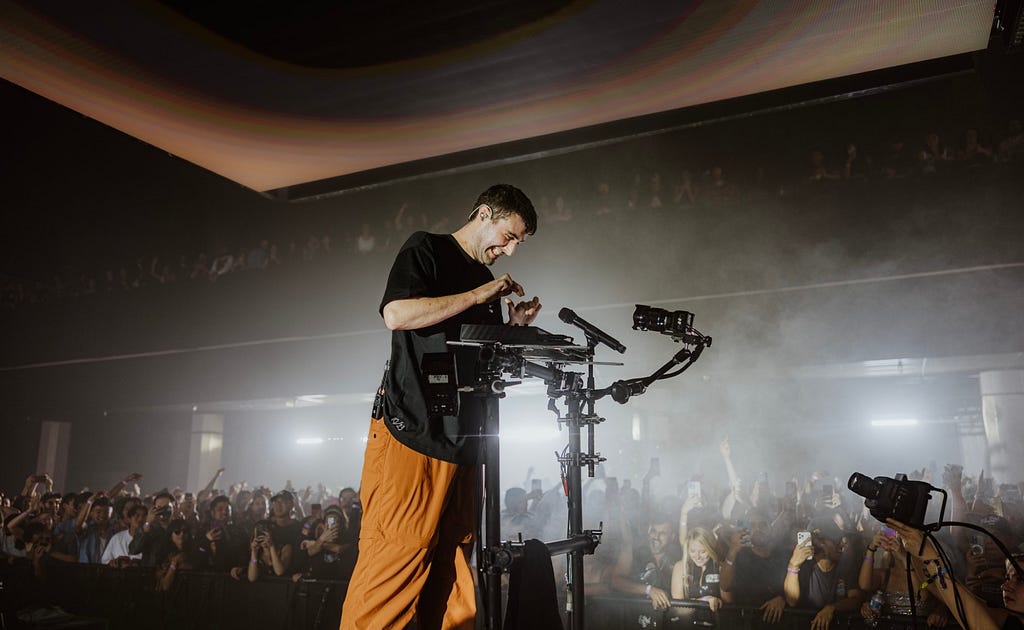
The Shapeshifters: Who’s Thriving in the Loop
Fred again..
The poster child for real-time evolution. He doesn’t just release music, he leaks emotion. Half of his catalog lives in voice notes and live set IDs. He’s skipping genre entirely and building a lane out of honesty, memory, and movement.
Skrillex
The architect of his own renaissance. One week he’s doing drum & bass with Flowdan. Next week it’s ambient glitch with Jónsi from Sigur Rós. No warning. No rollout. Just 34 tracks that sound like every genre and none. He didn’t come back, he reformatted.
Rezz
Built her name on midtempo darkness. Reinvented it with alt-rock collabs, cinematic structures, and even hypnotic trip-hop moments. She’s not stuck in her lane. She built her own planet.
Chase & Status
UK drum & bass royalty. But in 2023? They dropped “Baddadan”, a grime-fueled monster that hit №1, and did it without begging for playlist placements. Just TikTok heat, club fire, and a scene ready for a legend to mutate.
ISOxo / Knock2 / Hamdi
This isn’t genre. This is the post-SoundCloud renaissance, artists raised on chaos, pushing boundaries in real time. Their shows feel like raves and riots at once. Their tracks move through styles like a carousel with no brakes.
This is what the loop looks like when it works:
Not genre hopping. Genre sculpting.
The Ones on Ice
Now for the hard part.
Because no one wants to say this out loud:
Being loved once doesn’t protect you forever.
There are legends from the 2010s who still feel like household names, but whose output no longer resonates. Why? Not because the music is bad. But because it’s stuck in amber.
Benny Benassi. Dash Berlin. Nicky Romero. Vicetone. Gareth Emery.
These aren’t names we forgot. These are names the scene outpaced.
Their sound hasn’t changed. Their release structure hasn’t changed. Their digital footprint is sporadic at best. And in 2025, sporadic means invisible.
You drop one single every 8 months?
You’re not present. You’re archival.
The only thing more dangerous than losing your fanbase is letting your algorithmic ghost replace you.
That’s what happens when you move slow. When you wait for playlist support. When you think a six-month rollout in an age of six-second virality is still going to land. It won’t.
The fans are ready to support a comeback.
But they won’t wait for it.
The Evolution Loop
So what’s the fix?
How do you go from drifting into irrelevance to writing your next chapter?
You evolve. But not by chance, by design.
We call it The Evolution Loop.
A five-stage cycle that every modern electronic artist either understands… or gets eaten by.
,
1. Identity Lock
This is where it begins.
You find a sound. You build a brand. You get known for something, maybe it’s big-room euphorics, maybe it’s festival dubstep, maybe it’s progressive trance with a female vocal and a piano drop. It works. You lean in. You grow.
But here’s the thing:
The scene that loved you… keeps moving.
And you? You’re still playing that same 128 BPM anthem from 2013, waiting for it to hit again. But it doesn’t.
Welcome to the trap. The rut. The Lock.
,
2. Displacement
Now the landscape shifts.
New subgenres explode. Social platforms reset the rules. TikTok replaces blogs. A kid in his bedroom uploads something genreless and chaotic, and it connects harder than anything you’ve released in years.
You feel it. You know the numbers are dipping. You know the crowd isn’t reacting the same.
But your team says: “Stay the course.”
Your label says: “Let’s wait until Q4.”
Your gut says: “Something’s off.”
This is the moment of danger.
Most artists double down on what used to work.
But the smart ones? They get quiet. And then they get honest.
,
3. Reflection or Implosion
This is the fork in the road.
Do you burn out, or break through?
Some artists disappear. They blame the algorithm. They blame their audience. They post less. They release even less. They stop showing up.
Others shed the skin.
They stop chasing streams. They start chasing feeling.
They go back to the lab. They make weird shit. They get uncomfortable. They bring in collaborators that don’t make sense on paper, but make perfect sense in the booth.
This is where the real comeback begins.
Not with a song. With a shift.
,
4. Disruption
Here’s where everything breaks. On purpose.
You drop a track with no genre. No plan. No approval chain. You drop it because it’s now or never.
You ditch the rollout. You post an unfinished demo. You play an ID no one’s heard in a live set and let the fans carry it across TikTok. You do a collab with someone outside your circle. You make a song that your old fans might hate, but your future ones will never forget.
You stop asking permission.
You start reclaiming momentum.
This is the risk phase. It’s scary. It’s also your only shot.
,
5. Reintegration
Now you return, but different.
You don’t sound like you used to. But you feel even more like yourself.
Your old fans hear it and say, “Oh, they’re back.”
But your new fans don’t even know it’s a comeback. They just know it hits.
You release more. You move faster. You show your process. You let the music breathe. You let the fans in. You take up space, not because you’re trying to go viral…
but because you finally stopped hiding.
,
That’s the loop.
Every artist you admire right now? They’re somewhere on it.
Some are looping through for the second or third time. Others never made it past Phase 2.
But the ones winning in 2025? They’re the ones who disrupted, and re-emerged stronger.
And the ones who didn’t?
Well. You’re not hearing from them, are you?
,
The Danger of Standing Still
Here’s the part no one wants to say out loud:
Most of the EDM artists who defined the 2010s aren’t fading because they lost their skill.
They’re fading because they never updated the operating system.
They’re still running a 2014 playbook in a 2025 ecosystem.
Still chasing the same melodies, still working through the same label pipelines, still releasing like the internet didn’t shift the goalposts five years ago.
And it’s not just hurting their streams.
It’s killing their presence.
Let’s be real:
A Dash Berlin single in 2011 could spark a movement.
In 2025, it might not spark a notification.
Not because the music isn’t good.
Because it doesn’t move fast enough.
The fans? They’re still here. They’re waiting to care again. They’re still going to festivals. Still scrolling. Still nostalgic. But nostalgia doesn’t buy you oxygen anymore, only movement does.
Because the truth is brutal:
If you don’t evolve, the algorithm will erase you.
You’re not being shadowbanned. You’re being outpaced.
,
Meanwhile, the younger producers aren’t playing by genre rules at all.
They’re building identities off contrast.
They’ll drop a DnB track one week, then a Jersey club cut with trance vocals the next, and it works. Why? Because they’re not packaging sound. They’re sharing emotion in motion. Fast. Raw. Platform-native.
They don’t need playlist support.
They’ve got CapCut edits.
They don’t need lead time.
They’ve got unreleased clips from Boiler Room and TikTok Live.
They don’t wait.
They drop. They test. They adapt. In real time.
That’s not “luck.”
That’s agility. And agility wins now.
,
So here’s where the danger comes in:
A legacy artist in 2025 doesn’t just compete with their peers.
They compete with kids raised on SoundCloud chaos and TikTok hooks.
They compete with audiences who don’t care what genre you belong to, only what feeling you bring.
And if you’re still waiting for your label to greenlight a single?
Still timing a release around radio impact or quarterly marketing spend?
You’re already late.
And in this era, late means invisible.
,
The Return Loop
Let’s get one thing straight:
This isn’t a eulogy for the old guard.
It’s a blueprint for their return.
Because if 2025 has proven anything, it’s this:
There is a path back. But it’s not paved with old tricks.
Legacy EDM artists aren’t boxed out.
They’re boxed in, by teams, timelines, and assumptions that don’t belong in this decade.
The fans still care. The music still matters.
What’s broken is the process.
So here’s the new rulebook, stripped down and unforgiving:
1. Release faster. Release looser.
Perfection is dead. Momentum wins.
Drop the demo. Play the ID. Post the rough mix with the crowd reaction audio still baked in.
Let the moment move the track, not the campaign behind it.
If your track drops after the hype dies down, it’s not a release, it’s a eulogy.
2. Collaborate outside your comfort zone.
Don’t remake the anthem. Refract it through someone else.
Team up with a hyperpop artist. A DnB kid with 12K followers. A vocalist who doesn’t sing like your last 10 features.
Cross-pollination isn’t a risk, it’s a requirement.
Your sound isn’t sacred. It’s source code, rewrite it.
3. Build presence, not just playlists.
The people who win today? They show the work.
Clips in the studio. iPhone videos from the green room. TikToks mid-tour. Airdropping demos to the crowd during soundcheck.
Give people the story before the song, so they care by the time it hits.
If you’re not in the scroll, you’re not in the culture.
4. Say something. Anything. Just make it real.
Stop talking like a press release. Stop “teasing” your return with 3D logos and blackout posts.
Say what’s actually going on.
Tell them why you paused. Tell them what’s changing.
Let the fans into the loop, so they don’t have to guess if you’re still alive.
5. Get uncomfortable. And stay there.
If your new music feels like a sequel to something safe, scrap it.
The best projects right now feel risky, incomplete, raw, alive.
They feel like a jump without a landing.
If you’re not at least a little scared to release it, it’s probably not enough.
Because the truth?
2025 doesn’t need another comeback.
It needs a rebirth.
,
The stage isn’t gone. The fans aren’t gone.
But they’re watching how you return, not just if you return.
And the artists who figure that out?
They won’t just survive this wave.
They’ll shape the next one.
,